We tend to imagine life elsewhere in the universe as a series of separate beginnings. Somewhere, on some distant planet, the right chemistry comes together and produces the first living system. Elsewhere, the same improbable process happens again. Perhaps many times.
But what if the story could also be told in another way? What if some planetary systems did not begin with entirely separate chemical histories? What if they inherited related ingredients from the same ancient region of space, and later drifted far apart as the galaxy turned?
That possibility leads to a specific question: How far from Earth should we look for worlds that share part of the chemical history that preceded life here?
My starting point is not an assumption that living microorganisms traveled across the galaxy. It is simpler: before life existed, its chemical precursors had to be made somewhere, distributed through physical processes, and eventually incorporated into the material that formed planets. Matter takes time to travel. Therefore, any particular episode of chemical dispersal has a finite reach.
Before organisms, a shared chemical inheritance
Organic chemistry begins long before a planet becomes habitable. Molecules containing carbon, oxygen, hydrogen and nitrogen occur in cold clouds of gas and dust. Radiation and chemical reactions can gradually turn simpler substances into more complex ones, including molecules relevant to the origins of life.
Observations by the James Webb Space Telescope have identified complex organic molecules in interstellar ice and around forming stars. NASA’s analysis of asteroid Bennu has also identified amino acids and nucleobases used in life on Earth. None of these discoveries amounts to detecting life. They show that important ingredients of biology can exist in environments that predate living organisms. [1] [2] [3]
Now imagine a chemically rich cloud producing a family of stars and planetary systems. Each system forms from a different part of the cloud, but some ingredients have a common history. One planet eventually produces life. Others may—or may not—develop conditions in which similar chemistry can proceed further.
This is the shared-chemical-ancestry part of the hypothesis. It does not require microorganisms to travel between stars. Nor does it imply that the same chemistry cannot arise independently elsewhere in the universe.
The 130-light-year question
We can begin with an elementary constraint: distance equals speed multiplied by time. An object moving at 2 kilometers per second for 20 million years covers roughly 130 light-years, if we pretend it travels along a straight line at constant speed.
≈ 130 light-years
A thought-experiment travel distance—not a measured chemical boundary around the Sun.
For the model, I use an initial 130-light-year radius as a convenient starting assumption. That number is not established by observational astronomy. Real interstellar dust and gas do not simply fly in straight lines: they orbit the galaxy, interact, mix, and may be incorporated into stars before traveling anywhere near this far.
What matters is the principle, not the chosen number. A finite chemical source has a finite distribution history. The first practical problem would be to estimate the true size and mixing history of the molecular material from which Earth formed.
Birthplace and present address are not the same thing—not for a planet, and not for its star.
The galaxy does not stand still
Our Sun goes around the center of the Milky Way about once every 230 million years. Since its formation roughly 4.6 billion years ago, it has completed approximately twenty galactic orbits. [4]
Other stars move too, and not in exactly the same way. Differences in orbital speed, gravitational interactions, and the galaxy's changing structure can pull stars born close together into very different positions. Astronomers have simulated the dissolution of the Sun's possible birth cluster and found that its stellar siblings could have dispersed widely through the galactic disk, depending on the model. [5]
That changes how we should search. We cannot assume that a planet sharing Earth's chemical heritage would still be within a few dozen or a few hundred light-years. It could be much farther away today. Conversely, stars now near the Sun may have originated somewhere entirely different.
The result would not be a neatly bounded, permanent ring following one spiral arm. It would more likely be a moving, increasingly dispersed population of planetary systems, linked by ancestry rather than present-day proximity.
From shared chemistry to shared life
There is a second, more speculative stage. Suppose life does arise on one world. Asteroid impacts can eject rocks into space; a fraction of that material can escape its home system. In principle, some rocks might carry living microorganisms sheltered within them, and a much smaller fraction might eventually reach other planets.
This possibility is known as lithopanspermia. It has been explored in scientific research, particularly for stars that formed near one another in dense stellar clusters, where exchanges of rocky material can be more favorable. However, successful delivery of living organisms has never been observed, and more recent estimates suggest that the full process may be extremely unlikely. [6] [7]
There is nevertheless a useful mathematical distinction between one journey and a chain of journeys. If a living lineage establishes itself on a second planet, that planet could, in principle, become another source. Its descendants would no longer need to cross the entire distance from the first world in a single trip.
The chain could remain local, fail almost immediately, or—under very favorable assumptions—grow much larger while the stars themselves continue moving. What we lack is a reliable estimate for the chance of a successful biological transfer, including survival, arrival at a habitable world, and establishment of reproduction.
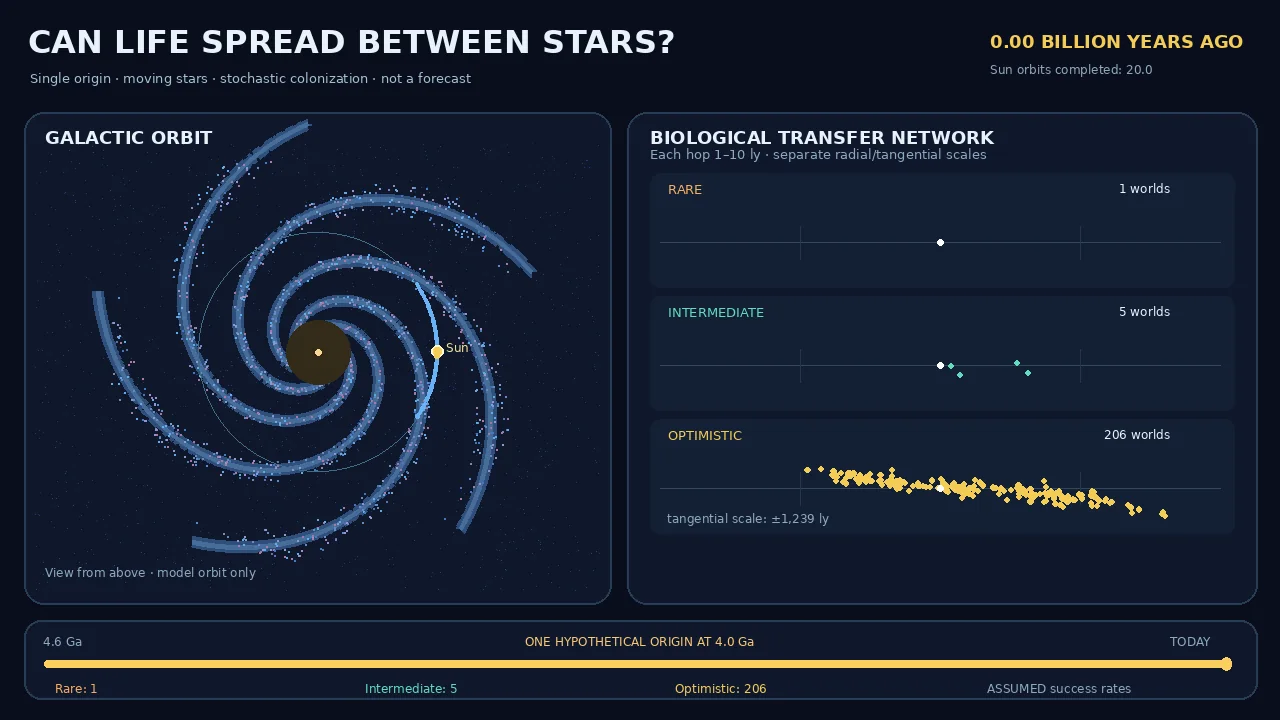
Could life spread between stars?
Move through 4.6 billion years of stellar motion and hypothetical transfers.
What the model actually shows
The simulation begins with a hypothetical group of stars sharing a 130-light-year chemical region, then allows them to move along slightly different galactic orbits. It also introduces one hypothetical origin of life 4.0 billion years ago. The biological model permits only short transfers between planetary systems, with no additional independent origins of life.
Each scenario assumes a different average rate of successful new colonizations per inhabited world per billion years. That rate is not a measured panspermia probability. It represents the combined effect of all the difficult steps: ejection, survival, capture, landing and establishment.
| Scenario | Assumed successes / world / billion years | Inhabited worlds in one run |
|---|---|---|
| Rare | 0.1 | 1 |
| Intermediate | 0.6 | 5 |
| Optimistic | 1.5 | 206 |
These are individual synthetic outcomes after four billion years of hypothetical biological spreading. They are not predictions or measurements. Different assumptions or random realizations would change the counts dramatically. The model is deliberately simplified; it is not a full three-dimensional dynamical or biological simulation.
In the optimistic run, the farthest seeded world finishes roughly 1,060 light-years from the original world. That does not mean any organism crossed 1,060 light-years in one journey. It is a consequence of repeated hypothetical transfers combined with the subsequent motion of the stars.
This distinction is central to the hypothesis. The distribution of a lineage after billions of years need not resemble the distance of any single transfer.
What would make the hypothesis testable?
The most useful next step would be to replace imaginary stars with actual astronomical data. Surveys such as Gaia can help identify stellar motions. Stellar ages and detailed chemical compositions can help search for candidates that may have formed alongside the Sun. Simulations can then estimate where those stars were in the distant past, subject to substantial uncertainties. [5]
We would also need better estimates of how organic material moves through star-forming clouds; how long complex molecules survive; how frequently rocky material travels between planetary systems; and whether organisms could survive the complete transfer process. The ultimate biological test would be evidence of life on another world—and enough information about its molecular machinery to compare it with Earth's.
Finding the same organic compounds on two planets would not prove a common origin. Many compounds can arise through ordinary chemistry. Even finding life on both worlds would not be enough by itself. Shared ancestry would require far more distinctive evidence, and the capacity to rule out independent evolution.
A question worth following
What interests me here is not the claim that the galaxy must already be inhabited. We do not know that. It is the possibility that the search for life has a historical dimension that distance alone obscures.
Two neighboring stars may be strangers, while two distant stars may once have formed from the same chemical environment. A lineage, if it could move between worlds at all, might travel only small distances at a time while its descendants end up scattered far beyond the range of any one journey.
Perhaps life is a collection of isolated beginnings. Perhaps some of it belongs to a wider family. Before we can answer that question, we may need to reconstruct not merely where stars are, but where they came from—and what traveled with them.
Sources and further reading
Scientific references document the observational and theoretical background. The specific shared-family hypothesis, its 130-light-year initial scale, and the accompanying numerical scenarios are presented here as exploratory assumptions, not established scientific results.
- NASA: Webb Unveils Dark Side of Pre-stellar Ice Chemistry — organic compounds in cold star-forming clouds.
- NASA: Webb Finds Ethanol, Other Icy Ingredients for Worlds — organic molecules around protostars.
- NASA: Asteroid Bennu Sample Reveals Mix of Life’s Ingredients — amino acids and nucleobases in returned samples.
- NASA: Sun — Facts — the Sun’s approximate 230-million-year galactic orbit.
- Martínez-Barbosa et al. (2016), The Evolution of the Sun’s Birth Cluster — simulated distributions of solar siblings.
- Adams & Spergel (2005), Lithopanspermia in Star-Forming Clusters — the possibility of rock exchange among nearby young stars.
- Adams & Napier (2022), Transfer of Rocks Between Planetary Systems: Panspermia Revisited — updated estimates of transfer likelihood.
This page is an independent exploratory essay by David Karlin, not a peer-reviewed scientific paper. The simulation is provided to make the assumptions visible and the underlying question easier to investigate.